About 247 minutes
Symbolic Logic — Background and Themes
Logic
56,629 recorded words. 10 minutes difference from this book's estimate.
View Gutenberg source #28696
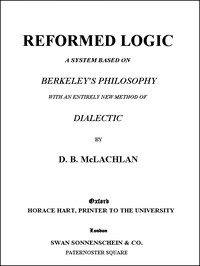
This digital edition of Reformed Logic A System Based on Berkeley's Philosophy with an Entirely New Method of Dialectic — Text and Context is described by source-level measurements including 54,390 words, 3 hr 57 min estimated reading time, and 8 detected text sections.
The text analysis averages about 22.3 words per sentence, while the detected sections provide another way to judge how the source is divided.
Project Gutenberg metadata also associates the work with “Logic,” connecting these edition facts with the source record’s subject description.
Explore this collection
These alternatives are selected using recorded categories and estimated reading time.
About 247 minutes
Logic
56,629 recorded words. 10 minutes difference from this book's estimate.
View Gutenberg source #28696About 223 minutes
Logic
51,254 recorded words. 14 minutes difference from this book's estimate.
View Gutenberg source #51548About 291 minutes
Logic
66,851 recorded words. 54 minutes difference from this book's estimate.
View Gutenberg source #37697Search stored excerpts and compare books → Choose by your preferences →
Choices use stored catalog measurements. Estimates vary with reading speed. A shared category is a catalog label, not a claim that two books have the same argument or literary quality.
Search reads excerpt text stored with this catalog and links to its associated Gutenberg record. The connection is stored in the site database; this tool does not recheck that every excerpt is word-for-word identical to that external record. Excerpt search does not cover every chapter and does not verify historical publication dates.
Catalog snapshot checked: 2026-09-25. Coverage: 94 public books, 94 available source excerpts.
Read the complete public-domain text at its original source.
Read on Project GutenbergMcLachlan opens by declaring that current logic textbooks are in a 'chaotic state' and that his system, based on Berkeley's philosophy, will make the nature of mind 'as comprehensible to beginners as other branches of knowledge.' He warns that Berkeley's philosophy, though reputedly difficult, should be judged by its explanatory power rather than initial plausibility. The preface sets a confident, reformist tone, promising a method that can be adapted even to realistic thinking by treating Berkeleyan categories as intuitions.
The treatise explicitly grounds itself in Berkeley's distinction between active spirits and passive ideas. McLachlan quotes Berkeley: 'Spirits are active, indivisible substances; Ideas [objects] are inert, fleeting, dependent things.' He modifies Berkeley's system, calling it 'Berkeleyism considerably modified,' and insists that a philosophy should be judged by its coherence and lucidity, not by surface paradox. The excerpts show him applying this framework to perception, arguing that what we call 'cubic space' is not real but a 'metaphor of perspective effacement.' He challenges realists to explain why we do not see cubic space in the sky or arrange stars by calculated distances, claiming the idealist answer presents no difficulty.
In the section on perspection, McLachlan analyzes how we perceive distance. He argues that the sky is not spaced because the conditions for terrestrial space are absent. Using the moon and planets as examples, he notes that a slight parallax is observable with close instrumental attention, but the calculated distances are 'not conceivable as associative distance.' He concludes that heavenly bodies are 'extremely degraded, perspectively speaking,' and their noumena are in contact with our minds, though the contact is 'infinitely slight' compared to what it would be if we could travel to them. This argument draws on Berkeley's Theory of Vision and Dialogues, which McLachlan cites as the source of his main points.
McLachlan introduces a category he calls 'concretion,' using a cricket-ball as an example. Turning the ball in the hand yields a series of discs, only one visible at a time; the whole object is an 'imaginary whole constructed in the intellect out of fragmentary experience.' He distinguishes concretion from inherence, association, and perspection. A striking claim follows: 'Things have no backs in the popular sense of the word.' When we turn a back to perceive it, it becomes a front. Everything is a 'flat upright surface,' and solidity can be imitated on a flat surface with nearly the same illusive completeness. He also discusses how two persons perceiving the 'same' object from opposite directions see numerically distinct objects, though they may be reduced to the same general idea.
McLachlan defines resistance as 'a negative term signifying the limit of our power to alter primary experience.' Where our power ceases, resistance begins. He references Dr. Johnson's famous refutation of Berkeley—kicking a stone—and reinterprets it: the experiment merely showed that not all means are adequate to change all primary experience. Johnson's kick did not disprove idealism; it only demonstrated that his power was insufficient to alter the post. This reinterpretation is characteristic of McLachlan's method: he takes a common objection and turns it into support for his system. The excerpts suggest that the book consistently applies this strategy, using everyday examples to illustrate abstract principles.
The excerpts reveal a work that is both a philosophical treatise and a pedagogical manual. McLachlan aims to make logic accessible, yet his arguments are dense and demand careful reading. Readers should attend to his definitions of key terms like 'perspection' and 'concretion,' and note how he uses Berkeley's ideas to challenge common-sense realism. The book's structure—moving from metaphysical foundations to specific categories—rewards sequential reading, but the later sections on dialectic may be adaptable to other frameworks, as the preface suggests.
That grey afternoon, McLachlan’s insistence on unclouded premises felt like a quiet window-sill, and his dialectic a slow breath. Later, my hand found another volume nearby, a gentler companion on teaching logic — A Class Room Logic Deductive and Inductive, with Special Application to the Science and Art of Teaching — Themes and Context — its classroom warmth a small echo of Berkeley’s steady light.
A brief reflection can help important ideas stay with you longer.