About 651 minutes
Prolegomena to the Study of Hegel's Philosophy, and Especially of His Logic — A Reader’s Guide
Logic
149,566 recorded words. 146 minutes difference from this book's estimate.
View Gutenberg source #54992
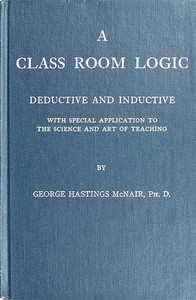
Before opening A Class Room Logic Deductive and Inductive, with Special Application to the Science and Art of Teaching — Themes and Context, the edition data offers a quick orientation: 115,972 words, 8 hr 25 min estimated reading time, and 37 detected text sections.
The text analysis averages about 14.9 words per sentence, while the detected sections provide another way to judge how the source is divided.
Project Gutenberg metadata also associates the work with “Logic,” connecting these edition facts with the source record’s subject description.
Explore this collection
These alternatives are selected using recorded categories and estimated reading time.
About 651 minutes
Logic
149,566 recorded words. 146 minutes difference from this book's estimate.
View Gutenberg source #54992About 332 minutes
Logic
76,336 recorded words. 173 minutes difference from this book's estimate.
View Gutenberg source #46330About 291 minutes
Logic
66,851 recorded words. 214 minutes difference from this book's estimate.
View Gutenberg source #37697Search stored excerpts and compare books → Choose by your preferences →
Choices use stored catalog measurements. Estimates vary with reading speed. A shared category is a catalog label, not a claim that two books have the same argument or literary quality.
Search reads excerpt text stored with this catalog and links to its associated Gutenberg record. The connection is stored in the site database; this tool does not recheck that every excerpt is word-for-word identical to that external record. Excerpt search does not cover every chapter and does not verify historical publication dates.
Catalog snapshot checked: 2026-09-25. Coverage: 94 public books, 94 available source excerpts.
Read the complete public-domain text at its original source.
Read on Project GutenbergGeorge Hastings McNair's A Class Room Logic opens with a preface that frames the book as an outgrowth of classroom work, aiming to remove difficulties that handicap the average student. The structure is immediately apparent: each chapter closes with a summary and review questions, and a briefer course is outlined for examination review. The text moves from deductive to inductive logic, with special application to teaching, and is punctuated by diagrams and illustrative exercises.
The book's structure is built around a clear hierarchy of argument forms. It begins with the syllogism, then moves to incomplete syllogisms (enthymemes), epicheiremas, polysyllogisms, and sorites. Each form is defined, illustrated, and then placed within a taxonomy. For example, enthymemes are classified into three orders based on which proposition is omitted, and sorites are divided into progressive and regressive types, each with its own rules. This systematic layering allows the reader to see how complex arguments are built from simpler components.
Every chapter concludes with a summary and a set of review questions. The summaries are concise, often using numbered lists to restate key points. For instance, the summary on irregular arguments lists five types and their characteristics. The review questions then test comprehension by asking for definitions, illustrations, and comparisons. This pattern is consistent throughout the book, reinforcing learning and providing a built-in study guide. The preface explicitly recommends that for a speedy review, the briefer course and chapter summaries be followed.
McNair frequently moves from abstract logical rules to concrete examples, often drawn from everyday reasoning or teaching contexts. In the section on irregular arguments, he presents quantitative arguments (e.g., A equals B, B equals C, therefore A equals C) and plurative arguments (e.g., most of the team are seniors, most are under twenty, therefore some students under twenty are seniors). These examples are not merely illustrative; they are used to demonstrate how arguments can be valid even when they do not conform to standard syllogistic rules. The text also encourages students to illustrate relations by circles, suggesting a visual approach to understanding.
Throughout the excerpts, there is an emphasis on diagrams and visual aids. The preface mentions that illustrative exercises and diagrams may be helpful in making clear abstruse topics. In the section on plurative arguments, the student is instructed to illustrate the overlapping of terms by circles. This visual element is a recurring feature, likely appearing in diagrams that accompany the text. The use of circles to represent logical relations is a classic tool, and McNair integrates it as a regular part of his pedagogical method, not just an occasional addition.
Readers approaching A Class Room Logic should note its dual purpose: to teach logical theory and to model effective teaching methods. The book's structure—with its summaries, reviews, and visual aids—is itself a lesson in pedagogy. Pay attention to how McNair moves from simple to complex forms, and how he uses examples to bridge theory and practice. This is a textbook that rewards careful study of its own architecture.
There’s something tender about how McNair builds each lesson on the last, those patient diagrams and review questions. It reminded me of evenings spent with Symbolic Logic — Background and Themes, where the same quiet care for structure felt like an old friend’s hand on my shoulder, guiding without hurry.
Use these questions to collect your thoughts before moving on.