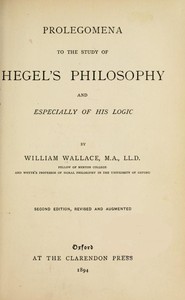
Wallace opens his Prolegomena by situating the reader within the mind's own developmental arc: from an initial state of being 'sunk in the living environment' to a reflective consciousness that 'floats freely above the real psychical life.' This movement is not merely epistemological but ontological—the mind must 'surrender all that it had hitherto clung to as its own' in order to achieve fuller being. The text insists that this process is neither linear nor effortless; it involves a necessary 'recoil' and a measurement of 'the full depth of its nonentity.' Wallace's language is deliberately paradoxical, presenting the mind as both the empty theatre of ideas and the power that makes the writing intelligible.
The Mind's Double Movement
Wallace describes a two-phase development: first, the mind withdraws from immersion in corporeity into a 'detached but somewhat shadowy self,' a mere logical ego that surveys its own psychical life as if from outside. This stage, he writes, is 'a great step' because it ceases to be 'absorbed in its qualities.' Yet this detachment is only preparatory. The second phase involves a return: the mind 'gradually recognises' that what it seemed to find in experience is 'its very and original own.' Through 'labour and experiment,' it fills the vacant form of consciousness and realises itself as 'a reason and a mind.' The text thus presents a dialectic of estrangement and recovery, where the empty self must first lose itself to find itself enriched.
From Inner Subjectivity to Objective Social Life
Wallace extends his analysis beyond the inner life to the practical and moral sphere. He posits an 'analogous or parallel development' in which man 'makes Nature his own, stamps it with his title of possession' and gives 'his fellowship with other souls an objective, outward existence in the forms and institutions of social life.' The first achievement here is 'the affirmation of his individuality' through property—the distinction of 'the Mine from the Thine.' This outward projection mirrors the inner movement: just as the individual soul becomes a 'solid, insoluble basis' in the inner life, so the personal being with property becomes the foundation of a world of 'mutually-recognised personalities.' The text thus ties abstract logical development to concrete social existence.
The Public Forum of Reason and Will
In the realm of 'free self-realised intelligence,' Wallace argues, we occupy a ground where 'others can equally come' and where there is 'nothing peculiar or merely individual.' He describes Knowledge and Will as a 'king's highway, a public forum, where souls meet and converse and perform a collective work.' Here 'mere individuality is at a discount.' This passage underscores the social and communal dimension of Hegelian logic: the highest stage of mind is not solitary contemplation but shared rational activity. The language of 'public forum' and 'collective work' suggests that for Wallace, Hegel's Logic is not an abstract system but a description of how reason becomes objective in shared human practices.
Wallace's Prolegomena is best approached as a companion that traces the logical movement of mind from its most abstract self-relation to its concrete embodiment in social institutions. Readers should attend to his recurring contrast between the 'empty room' of mere consciousness and the 'all-embracing' character of reason. The text rewards those who follow its dialectical shifts without expecting a linear argument; its value lies in the precision with which it maps the stages of spirit's self-discovery.
Reading Wallace’s Prolegomena, I often felt the slow pull of thought freeing itself from the world’s grip. It made me think of that quiet old sermon collection, Creed and Deed: A Series of Discourses — Edition Insights, where belief feels less like an answer and more like a gesture. Both speak to a restlessness I’ve never quite outgrown.