About 61 minutes
Ethics — Part 5 — A Reader’s Guide
Political Philosophy
13,885 recorded words. 18 minutes difference from this book's estimate.
View Gutenberg source #975
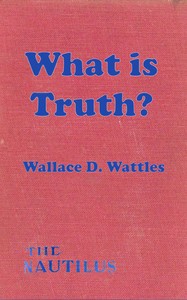
For What is truth? — Edition Insights, the stored edition analysis reports 9,734 words, 43 min estimated reading time, and 8 detected text sections.
The text analysis averages about 23.9 words per sentence, while the detected sections provide another way to judge how the source is divided.
Project Gutenberg metadata also associates the work with “Essays,” connecting these edition facts with the source record’s subject description.
Explore this collection
These alternatives are selected using recorded categories and estimated reading time.
About 61 minutes
Political Philosophy
13,885 recorded words. 18 minutes difference from this book's estimate.
View Gutenberg source #975About 83 minutes
Political Philosophy
19,075 recorded words. 40 minutes difference from this book's estimate.
View Gutenberg source #13766About 94 minutes
Political Philosophy
21,394 recorded words. 51 minutes difference from this book's estimate.
View Gutenberg source #920Search stored excerpts and compare books → Choose by your preferences →
Choices use stored catalog measurements. Estimates vary with reading speed. A shared category is a catalog label, not a claim that two books have the same argument or literary quality.
Search reads excerpt text stored with this catalog and links to its associated Gutenberg record. The connection is stored in the site database; this tool does not recheck that every excerpt is word-for-word identical to that external record. Excerpt search does not cover every chapter and does not verify historical publication dates.
Catalog snapshot checked: 2026-09-25. Coverage: 94 public books, 94 available source excerpts.
Read the complete public-domain text at its original source.
Read on Project GutenbergW. D. Wattles opens What Is Truth? by insisting that time is a real, ongoing succession independent of human measurement or the existence of heavenly bodies. He rejects the notion that time is merely an idea or a fiction, asserting that hours and minutes would continue even in formless chaos. This concrete, almost defiant claim sets the tone for a work that seeks to ground metaphysical speculation in what Wattles calls “realities” behind appearances.
The essay series, originally published in The Nautilus from April to September 1909, proceeds to treat space, substance, and motion as equally real. Wattles builds a systematic cosmology in which a single, conscious, fluid substance fills all space, and all motion arises from pressure—an idea he traces through gravity, light, heat, and electricity. His diction is direct and expository, often using analogies (a balloon and a stone) to collapse apparent dualities into one underlying force.
Wattles devotes the first section to defending the reality of time against metaphysical writers who call it an illusion. He argues that time would continue at the same rate even if the heavenly bodies stood still, and that hours and minutes would persist through black, silent chaos. This is not a mere philosophical aside; it establishes his method of reasoning from everyday experience to first principles. He distinguishes between the succession of days and seasons—which depend on planetary motion—and the underlying duration of hours and minutes, which he treats as absolute. The argument is built on a series of hypotheticals: if the earth stopped rotating, day and night would become continuous, but time would not cease. Wattles’s language is plain and repetitive for emphasis, as when he writes “hours and minutes would go on forever.” This section reveals his commitment to a universe governed by fixed, independent realities rather than human perception.
Having established time and space as real, Wattles turns to substance and motion. He posits a single, conscious, fluid substance that fills all space. Motion, he argues, is caused by pressure of substance against substance, and all so-called forces—gravity, light, heat, electricity—are merely different rates and modes of this one pressure. He explicitly rejects the idea of universal attraction between bodies, replacing it with universal pressure that impels bodies toward each other in an orderly way. The prose is methodical, building from definition to conclusion: “force and motion are mutually convertible, each into the other.” Wattles’s vocabulary is technical but accessible, favoring terms like “pressure,” “density,” and “rigidity.” He does not cite experiments or authorities; instead, he relies on logical deduction from his initial premises. This section exemplifies his effort to construct a unified physical theory from metaphysical first principles.
Wattles argues that motion cannot begin in conscious substance without an act of will. He asks readers to conceive of space filled with completely conscious, motionless fluid, and then to imagine motion starting—an act he says is unthinkable without will. From this, he deduces that the original creative motions of the universe could only have begun by an act of will of “Original Conscious Substance,” which he identifies with God. This will-pressure, he explains, packs substance together, making it dense and rigid, and originates light, heat, electricity, and magnetism. Gravity itself is defined as this will-pressure drawing substance together. Wattles uses the example of an apple falling and the earth holding its orbit as manifestations of the same divine pressure. He concludes that if God’s will were relaxed, the earth would instantly return to its original fluid state. The reasoning is circular but consistent: every phenomenon of force or motion traces back to a single, intelligent will.
Wattles’s authorial voice is marked by declarative sentences, frequent repetition of key terms, and a refusal to qualify his claims. Phrases like “we see that” and “there is no accounting for” appear throughout, framing his deductions as self-evident. He uses analogies sparingly but effectively—the balloon and stone, the apple and earth—to collapse apparent opposites into a single cause. His paragraphs are dense, often containing multiple linked assertions without transitional hedging. The word “substance” recurs dozens of times, always treated as a real, conscious entity. Wattles also employs a distinctive rhetorical move: he anticipates objections (e.g., “Do not misunderstand me”) and then dismisses them with counterexamples. This style creates an impression of inexorable logic, even when the premises are speculative. Readers should note that the excerpts end before Wattles applies his cosmology to ethics or health, so the full scope of his argument remains incomplete in this edition.
Wattles’s essay series is best approached as a work of speculative metaphysics rather than empirical science. His arguments rely on logical deduction from a few chosen premises—time is real, substance is conscious, motion requires will—and he does not engage with alternative theories or evidence. Readers interested in early twentieth-century New Thought cosmology will find a clear, assertive example of its method. The text rewards attention to its rhetorical structure and the way Wattles builds a unified system from everyday observations.
That rainy afternoon, Wattles’s insistence on a single conscious substance pressing through all things stayed with me—quiet, relentless, like the drumming on the window. I felt the world as weight and urge, not just shape. Later, almost without deciding, I reached for a book that named this very force as will: The World as Will and Idea (Vol. 1 of 3) — Story, Setting & Ideas. One idea simply opened onto another.
A brief reflection can help important ideas stay with you longer.