About 743 minutes
The World as Will and Idea (Vol. 2 of 3) — Reading Notes
Political Philosophy
170,767 recorded words. 19 minutes difference from this book's estimate.
View Gutenberg source #40097
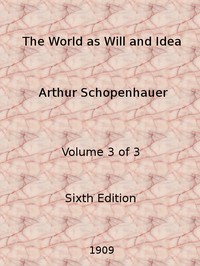
For The World as Will and Idea (Vol. 3 of 3) — Edition Insights, the stored edition analysis reports 175,042 words, 12 hr 42 min estimated reading time, and 38 detected text sections.
The text analysis averages about 25.8 words per sentence, while the detected sections provide another way to judge how the source is divided.
Project Gutenberg metadata also associates the work with “Philosophy,” connecting these edition facts with the source record’s subject description.
Explore this collection
These alternatives are selected using recorded categories and estimated reading time.
About 743 minutes
Political Philosophy
170,767 recorded words. 19 minutes difference from this book's estimate.
View Gutenberg source #40097About 743 minutes
Political Philosophy
170,771 recorded words. 19 minutes difference from this book's estimate.
View Gutenberg source #55046About 846 minutes
Political Philosophy
194,563 recorded words. 84 minutes difference from this book's estimate.
View Gutenberg source #38427Search stored excerpts and compare books → Choose by your preferences →
Choices use stored catalog measurements. Estimates vary with reading speed. A shared category is a catalog label, not a claim that two books have the same argument or literary quality.
Search reads excerpt text stored with this catalog and links to its associated Gutenberg record. The connection is stored in the site database; this tool does not recheck that every excerpt is word-for-word identical to that external record. Excerpt search does not cover every chapter and does not verify historical publication dates.
Catalog snapshot checked: 2026-09-25. Coverage: 94 public books, 94 available source excerpts.
Read the complete public-domain text at its original source.
Read on Project GutenbergSchopenhauer opens this supplementary volume by insisting that the intellect is subordinate to the will, a claim he supports through a striking natural analogy. Observing insects in autumn—some spinning cocoons, others laying eggs before dying—he argues that death and sleep are not radically different. The insect that dies is identical in essence to the one hatched in spring, just as the man who goes to sleep is the same as the one who wakes. This metaphor of the leaf and the tree recurs throughout the chapter, with Schopenhauer addressing a hypothetical foolish leaf that laments its fall, unaware that it shares its nature with the tree's future leaves.
In Chapter XXI, Schopenhauer characterizes the intellect as subordinate, a tool of the will. He writes that without this subordination, “everything which takes place without it” would be inexplicable. The intellect, he claims, is not the primary driver of action but a secondary faculty that serves the will's ends. This view contrasts with rationalist traditions that place reason at the center of human agency. Schopenhauer's language is direct: the intellect is “of a subordinate nature,” a claim he reinforces by pointing to instinctual behaviors in animals and humans that operate without conscious deliberation. The chapter's title, “Retrospect and More General View,” signals that he is stepping back to synthesize earlier arguments, but his focus remains on the will's primacy.
Schopenhauer's meditation on insects leads to what he calls “nature's great doctrine of immortality.” He observes the care with which an insect prepares a cell, deposits an egg, and dies, comparing it to a man laying out clothes for the next morning before sleep. The insect's death, he argues, is no more final than sleep, because the true nature of the insect persists in the egg and the following spring's hatchling. He extends this to humans: the future generations are not created from nothing but exist already in the present, in the “real” that is always present. The leaf that laments “I am not these! These are quite different leaves!” is mistaken, for it fails to recognize its identity with the tree's ongoing life. Schopenhauer's rhetoric here is both poetic and philosophical, using the cycle of seasons to challenge linear notions of birth and death.
Schopenhauer directly addresses a hypothetical questioner who asks where future generations come from. The answer is a rebuke: “Where else should they be than there where alone the real always was and will be, in the present and its content?” The questioner, he says, is like the foolish leaf, mistaking his own nature. The passage culminates in a Greek quotation from Homer—οἱη περ φυλλων γενεη, τοιηδε και ανδρων (“as is the generation of leaves, so is that of men”)—tying his argument to classical literature. This rhetorical strategy, blending philosophical assertion with literary allusion, is characteristic of Schopenhauer's style. He does not prove his point through empirical evidence but through analogy and the force of his prose, challenging the reader to recognize the will's persistence beyond individual existence.
Readers approaching this volume should note that it is a supplement, not a standalone work; Schopenhauer frequently refers back to arguments from the first two books. The excerpts show his method: building a philosophical case through vivid natural imagery and direct address to the reader. Pay attention to how he uses metaphors—the leaf, the insect, the tree—to make abstract claims about the will tangible. His tone is urgent, even combative, as he insists on the identity of the individual with the species.
Schopenhauer’s leaf falls from the eternal tree, yet he insists the will keeps whispering through every green turn. I find that same stubborn whisper in the quiet pages of Ethics — Part 5 — A Reader’s Guide, where reason learns to breathe more gently. Two old friends, talking of endurance, without ever raising their voices.
Capture what you thought, learned, and would like to remember.