About 743 minutes
The World as Will and Idea (Vol. 2 of 3) — Reading Notes
Political Philosophy
170,767 recorded words. 0 minutes difference from this book's estimate.
View Gutenberg source #40097
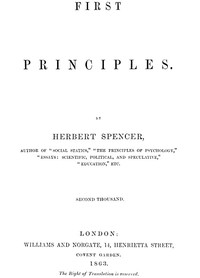
The source record for First Principles — Themes and Context measures this digital text at 170,771 words, 12 hr 23 min estimated reading time, and 20 detected text sections.
The text analysis averages about 31.1 words per sentence, while the detected sections provide another way to judge how the source is divided.
Project Gutenberg metadata also associates the work with “Philosophy and religion,” connecting these edition facts with the source record’s subject description.
Explore this collection
These alternatives are selected using recorded categories and estimated reading time.
About 743 minutes
Political Philosophy
170,767 recorded words. 0 minutes difference from this book's estimate.
View Gutenberg source #40097About 762 minutes
Political Philosophy
175,042 recorded words. 19 minutes difference from this book's estimate.
View Gutenberg source #40868About 846 minutes
Political Philosophy
194,563 recorded words. 103 minutes difference from this book's estimate.
View Gutenberg source #38427Search stored excerpts and compare books → Choose by your preferences →
Choices use stored catalog measurements. Estimates vary with reading speed. A shared category is a catalog label, not a claim that two books have the same argument or literary quality.
Search reads excerpt text stored with this catalog and links to its associated Gutenberg record. The connection is stored in the site database; this tool does not recheck that every excerpt is word-for-word identical to that external record. Excerpt search does not cover every chapter and does not verify historical publication dates.
Catalog snapshot checked: 2026-09-25. Coverage: 94 public books, 94 available source excerpts.
Read the complete public-domain text at its original source.
Read on Project GutenbergHerbert Spencer's First Principles (1862) opens with a prospectus for a multi-volume 'System of Philosophy,' positioning this volume as the foundation for works on biology, psychology, and sociology. The text is divided into two parts: 'The Unknowable' and 'Laws of the Knowable.' Spencer explicitly builds on the doctrines of Hamilton and Mansel, aiming to reconcile science and religion by asserting an Absolute that transcends knowledge. The excerpts reveal a dense, argumentative style that moves between metaphysical abstraction and scientific axioms, such as the persistence of force.
Spencer's central claim is that religion and science share a fundamental agreement: both must posit an 'Unconditioned Reality' that cannot be known. He writes that 'the Non-relative cannot be known' yet is 'an actual existence.' This is not a compromise but a logical necessity: without this postulate, religion lacks subject-matter and science lacks its 'indispensable datum.' The excerpts show Spencer repeatedly circling back to this idea, using terms like 'Absolute Force' and 'Unknown Cause' to describe the same underlying concept. He argues that the persistence of force, a key scientific principle, ultimately refers to 'some Power which transcends our knowledge and conception.' This move allows him to claim that scientific inquiry itself leads to the same conclusion as religious intuition.
In the section on 'Laws of the Knowable,' Spencer treats the persistence of force as the foundational axiom from which all other scientific truths derive. He argues that the indestructibility of matter and the continuity of motion are 'corollaries from the impossibility of establishing in thought a relation between something and nothing.' The excerpts show him engaging in a kind of transcendental deduction: because we cannot conceive of force beginning or ending, we must posit it as persistent. This is not an empirical observation but a condition of thought itself. Spencer's language is precise and repetitive, hammering home the idea that 'the force of which we assert persistence is that Absolute Force of which we are indefinitely conscious.' The argument is tightly structured, moving from subjective analysis to objective analysis to show that both require the same ultimate postulate.
The excerpts reveal a systematic, almost architectural method. Spencer numbers his sections (e.g., §75) and uses frequent cross-references to earlier chapters. The prose is formal and declarative, with long sentences that build logical chains. For example, he writes: 'Thus, by the persistence of Force, we really mean the persistence of some Power which transcends our knowledge and conception.' The text is also marked by a recurring pattern: Spencer states a proposition, then restates it from multiple angles—religious, scientific, subjective, objective. This redundancy is deliberate, aiming to show that the same truth emerges from different starting points. The excerpts do not include the biological or sociological applications promised in the prospectus, so the reader encounters only the abstract foundation. The tone is confident and polemical, as Spencer positions his system against both orthodox religion and materialist science.
Readers approaching First Principles should note that the excerpts represent only the philosophical core of a much larger project. The text is dense with argumentation and assumes familiarity with mid-19th-century debates in metaphysics and science. Spencer's style rewards careful attention to his definitions and logical steps. The work is best read as a systematic treatise rather than a popular exposition, and its claims about the Unknowable should be evaluated in light of the full argument, not just the excerpts provided here.
Reading about Spencer’s Unknowable, I remembered sitting on my grandfather’s porch, the summer heat thick as honey, trying to grasp something just beyond reach. The World as Will and Idea (Vol. 3 of 3) — Edition Insights gave me that same hush—a quiet surrender to the vastness beneath our everyday thoughts, like watching dusk soften the edges of the world.
Capture what you thought, learned, and would like to remember.