About 1,210 minutes
The guide for the perplexed — Reading Notes
Ethics
278,170 recorded words. 1280 minutes difference from this book's estimate.
View Gutenberg source #73584
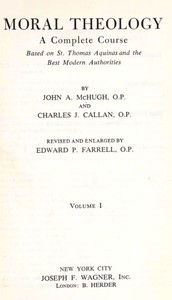
The source record for Moral Theology A Complete Course Based on St. Thomas Aquinas and the Best Modern Authorities — Reading Notes measures this digital text at 572,500 words, 41 hr 30 min estimated reading time, and 83 detected text sections.
The text analysis averages about 24.7 words per sentence, while the detected sections provide another way to judge how the source is divided.
Project Gutenberg metadata also associates the work with “Christian ethics -- Catholic authors,” connecting these edition facts with the source record’s subject description.
Explore this collection
These alternatives are selected using recorded categories and estimated reading time.
About 1,210 minutes
Ethics
278,170 recorded words. 1280 minutes difference from this book's estimate.
View Gutenberg source #73584About 1,087 minutes
Ethics
249,817 recorded words. 1403 minutes difference from this book's estimate.
View Gutenberg source #39155About 897 minutes
Ethics
206,181 recorded words. 1593 minutes difference from this book's estimate.
View Gutenberg source #40435Search stored excerpts and compare books → Choose by your preferences →
Choices use stored catalog measurements. Estimates vary with reading speed. A shared category is a catalog label, not a claim that two books have the same argument or literary quality.
Search reads excerpt text stored with this catalog and links to its associated Gutenberg record. The connection is stored in the site database; this tool does not recheck that every excerpt is word-for-word identical to that external record. Excerpt search does not cover every chapter and does not verify historical publication dates.
Catalog snapshot checked: 2026-09-25. Coverage: 94 public books, 94 available source excerpts.
Read the complete public-domain text at its original source.
Read on Project GutenbergThe 1958 edition of Moral Theology by John A. McHugh and Charles J. Callan, revised by Edward P. Farrell, presents itself as a complete course grounded in St. Thomas Aquinas and supplemented by modern authorities. The preface explicitly aims to avoid digressions into canon law, dogmatic theology, or history, focusing instead on moral questions. Yet the excerpts reveal a persistent tension: the work constantly negotiates between abstract principles and concrete legal rules, between the theologian’s reasoning and the canonist’s code.
The preface announces a deliberate narrowing of scope: the authors intend to treat moral theology as a systematic whole, avoiding “alien fields” such as canon law or dogmatic theology. This is a response to the proliferation of specialized commentaries after the 1917 Code of Canon Law. However, the excerpts show that the line is difficult to maintain. In the discussion of restitution (sections 1788–1791), the text moves fluidly between moral principles (e.g., the order of preference among creditors based on justice) and civil law provisions (e.g., American bankruptcy rules). The authors do not simply cite the civil law; they integrate it as a practical norm, noting that “the order of preference among creditors according to civil law is generally as follows.” This suggests that the work’s systematic ambition is constantly checked by the need to address real-world legal frameworks.
The excerpts on restitution illustrate a hallmark of the casuistic method: exhaustive enumeration of cases. Section 1790 lists multiple scenarios for the “amount” of restitution when an object changes value during possession in bad faith, distinguishing internal vs. external causes and improvements vs. deteriorations. The text weighs competing opinions—e.g., whether uncertain debts need be paid only “in proportion to their probability.” This approach reflects the authors’ stated goal of not sacrificing “essentials for accidentals,” yet the sheer volume of distinctions risks overwhelming the reader. The underlying principle (the duty to restore what is unjustly taken) is clear, but the application requires navigating a thicket of hypotheticals. The work thus embodies a tension between the simplicity of moral law and the complexity of human transactions.
The text frequently invokes authority: St. Thomas Aquinas is the foundation, but the authors also cite “the best modern authorities” and refer to “common opinion” or “some” versus “others.” In the discussion of creditor priority, the work presents multiple views without always settling the matter: “Creditors who are certain are by some preferred to creditors who are uncertain; but others think that payment to the poor… is the latter’s presumed will.” This openness to divergent opinions is characteristic of moral theology as a discipline that reasons probabilistically. Yet the presence of the nihil obstat and imprimatur (from 1958) signals that the work operates within a defined doctrinal framework. The tension between authoritative teaching and scholastic debate is palpable: the text must guide consciences while acknowledging that reasonable theologians may disagree.
Readers approaching this work should expect a dense interplay of principle and case law. The authors’ effort to be comprehensive means that the text often reads like a legal manual as much as a theological treatise. Pay attention to how the authors balance the authority of Aquinas with the demands of modern civil codes and the diversity of theological opinions. The work rewards careful study but requires patience with its taxonomic structure.
There is something almost tender in how these old moralists tried to map every corner of human choice, as if rules could hold back the tide. I find myself thinking of Motherhood and the Relationships of the Sexes — Reading Notes, where the same careful grid meets the messiest parts of life. Both leave me quietly wondering how much we can ever really codify.
Answer a few questions and save a private reflection on this device.