About 58 minutes
Socialism Exposed — A Reader’s Guide
Ethics
13,241 recorded words. 1 minutes difference from this book's estimate.
View Gutenberg source #62506
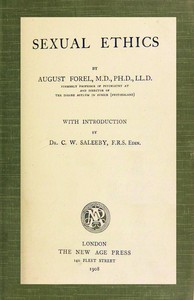
The source record for Sexual ethics — Story, Setting & Ideas measures this digital text at 13,412 words, 59 min estimated reading time, and 8 detected text sections.
The text analysis averages about 23.2 words per sentence, while the detected sections provide another way to judge how the source is divided.
Project Gutenberg metadata also associates the work with “Sexual ethics,” connecting these edition facts with the source record’s subject description.
Explore this collection
These alternatives are selected using recorded categories and estimated reading time.
About 58 minutes
Ethics
13,241 recorded words. 1 minutes difference from this book's estimate.
View Gutenberg source #62506About 65 minutes
Ethics
14,862 recorded words. 6 minutes difference from this book's estimate.
View Gutenberg source #34267About 51 minutes
Ethics
11,650 recorded words. 8 minutes difference from this book's estimate.
View Gutenberg source #29508Search stored excerpts and compare books → Choose by your preferences →
Choices use stored catalog measurements. Estimates vary with reading speed. A shared category is a catalog label, not a claim that two books have the same argument or literary quality.
Search reads excerpt text stored with this catalog and links to its associated Gutenberg record. The connection is stored in the site database; this tool does not recheck that every excerpt is word-for-word identical to that external record. Excerpt search does not cover every chapter and does not verify historical publication dates.
Catalog snapshot checked: 2026-09-25. Coverage: 94 public books, 94 available source excerpts.
Read the complete public-domain text at its original source.
Read on Project GutenbergAuguste Forel opens his 1908 treatise Sexual Ethics with a blunt declaration: the ideal marriage is a monogamous union founded on mutual affection, loyalty, and the birth of several children. This is not a gentle suggestion but a thesis he defends with the force of a psychiatrist and biologist. Forel’s prose is direct, often dogmatic, and unafraid to label opposing views as “senseless” or “barbarous.” He writes from a conviction that the sexual question is “concerned with nothing less than the life of this world to come,” and his argumentative strategy relies on stark contrasts between natural function and social hypocrisy.
Forel’s diction is marked by categorical assertions. He writes that “the ideal marriage is undoubtedly a monogamous union” and that certain practices “cannot be too vigorously combated.” This tone of certainty is reinforced by his use of rhetorical questions, such as “Is it not senseless … to declare the existence of a child … to be legal or illegal?” Such questions assume a shared rational ground with the reader, while his answers leave no room for ambiguity. The effect is a text that reads less as an inquiry and more as a manifesto, with each paragraph advancing a clear, often provocative, position.
Forel repeatedly frames sexual activity as a “natural function,” contrasting it with the “gross ignorance” and “concealment” imposed by society. He argues that women should be “proud of becoming a mother” and that pregnancy should be “frankly and naturally treated.” This vocabulary of nature versus artifice underpins his entire ethical system. He does not merely describe; he prescribes, insisting that “the highest freedom of man lies in his mastery of self.” The interplay between natural instinct and self-control is a recurring structural tension in his argument.
Forel’s call for legal equality is striking for its era. He demands “a complete separation of property” between spouses and “a just and proper valuation of every service performed by the wife.” He also advocates naming all children after the mother to achieve “complete equality.” These proposals are presented as logical extensions of his ethical principles, not as concessions to feminism. His language is legalistic and procedural, focusing on registrars, declarations, and responsibilities. Yet the tone remains impassioned, as when he decries the distinction between legitimate and illegitimate children as a “remnant of a barbarous code of morals.”
Forel distinguishes between external legal compulsion and inward self-repression. He argues that the state cannot compel fidelity—that “external constraint begets only hypocrisy, strife, and treachery.” Instead, the law should protect children and ensure parental responsibility. This nuanced position reveals a thinker wary of overreach, even as he advocates sweeping reforms. His prose shifts between the abstract (“the highest freedom of man”) and the concrete (“every woman who is healthy and strong should be proud of becoming a mother”), creating a layered argument that is both idealistic and pragmatic.
Ashley Dukes’ translation preserves Forel’s emphatic style, though the English edition is introduced by Dr. C. W. Saleeby, who notes that Forel “needs an introduction to any intelligent audience in any civilised country.” Saleeby’s introduction frames the work within the eugenics movement, using phrases like “the culture of the racial life” and “the vital industry of any people.” This framing may color the reader’s reception, but Forel’s own voice remains dominant: direct, urgent, and unapologetically prescriptive.
Readers approaching Sexual Ethics should be prepared for a text that argues with conviction rather than nuance. Forel’s brevity—the treatise runs just over 13,000 words—means each sentence carries weight. His proposals, from maternal naming to legal equality, were radical for 1908 and remain provocative. The book is best read as a primary document of early twentieth-century reformist thought, where biology, ethics, and law intersect in a single, forceful argument.
That Forel book left me thinking about how bluntly we once framed intimacy—almost clinical, yet oddly tender in its conviction. It reminded me of evenings spent with The Philosophy of History, Vol. 1 of 2 — Edition Insights, where the past feels less like dates and more like quiet arguments still echoing. Both linger—not loudly, but like a familiar ache you keep returning to.
Create a short personal record of your experience with this book.