About 775 minutes
Chaucer's Translation of Boethius's "De Consolatione Philosophiae" — Inside the Classic
Ethics
178,151 recorded words. 32 minutes difference from this book's estimate.
View Gutenberg source #42083
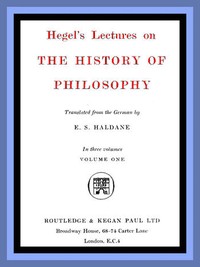
Before opening Hegel's Lectures on the History of Philosophy: Volume 1 (of 3) — Background and Themes, the edition data offers a quick orientation: 170,879 words, 12 hr 23 min estimated reading time, and 29 detected text sections.
The text analysis averages about 26.7 words per sentence, while the detected sections provide another way to judge how the source is divided.
Project Gutenberg metadata also associates the work with “Philosophy -- History,” connecting these edition facts with the source record’s subject description.
Explore this collection
These alternatives are selected using recorded categories and estimated reading time.
About 775 minutes
Ethics
178,151 recorded words. 32 minutes difference from this book's estimate.
View Gutenberg source #42083About 696 minutes
Ethics
160,051 recorded words. 47 minutes difference from this book's estimate.
View Gutenberg source #23639About 793 minutes
Ethics
182,337 recorded words. 50 minutes difference from this book's estimate.
View Gutenberg source #47244Search stored excerpts and compare books → Choose by your preferences →
Choices use stored catalog measurements. Estimates vary with reading speed. A shared category is a catalog label, not a claim that two books have the same argument or literary quality.
Search reads excerpt text stored with this catalog and links to its associated Gutenberg record. The connection is stored in the site database; this tool does not recheck that every excerpt is word-for-word identical to that external record. Excerpt search does not cover every chapter and does not verify historical publication dates.
Catalog snapshot checked: 2026-09-25. Coverage: 94 public books, 94 available source excerpts.
Read the complete public-domain text at its original source.
Read on Project GutenbergThis volume opens not with a single authorial voice but with a layered editorial history. The translator, E.S. Haldane, explains that the text was assembled from nine lecture courses delivered between 1805 and 1830, with only the Jena course fully written out by Hegel himself. Later courses relied on extempore speaking, marginal annotations, and student notes. The result is a work that shifts between terse abstract summaries and expansive, dialectical exposition—a texture that reflects Hegel's own evolving method.
The excerpts show Hegel moving from broad periodization to close analysis of individual thinkers. His treatment of Xenophanes, for instance, moves from a general characterization of the Eleatic school to specific fragments, including Xenophanes' critique of anthropomorphic gods. Hegel's own voice emerges in evaluative phrases: such physical opinions 'can have no great interest,' he remarks, distinguishing speculative significance from mere natural philosophy.
The text's composite nature is evident in its abrupt changes of pace. The translator's note reveals that the Jena manuscript serves as a 'skeleton' later fleshed out with material from later courses. This produces a work where dense, almost note-like passages alternate with more discursive sections. In the Xenophanes section, Hegel moves from a compressed definition—'a double consciousness; a pure consciousness and consciousness of Being, and a consciousness of opinion'—to a longer discussion of the philosopher's critique of Homer and Hesiod. The reader encounters both the condensed abstract and the elaborated lecture.
Haldane's translation aims for literal fidelity, which sometimes results in sentences that retain German syntactic structures. This can slow the reading pace, especially in passages where Hegel is working through a dialectical progression. The effect is a text that demands careful parsing, rewarding those who attend to its structural cues.
Hegel's treatment of Parmenides illustrates his characteristic method: he situates the philosopher chronologically, cites ancient sources (Diogenes Laertius, Plato), and then moves to philosophical assessment. The pace quickens when Hegel contrasts Parmenides with Xenophanes, noting that Parmenides 'arrives at more definite conceptions.' The narrative voice becomes more assured, even as it acknowledges gaps in historical knowledge—'what is strictly historical in it cannot be ascertained.'
Hegel frequently inserts evaluative judgments that signal his own philosophical commitments. Of Xenophanes' physical opinions, he writes they 'can have no great interest' and 'are meant to have no speculative significance.' Such remarks reveal Hegel's hierarchy of philosophical value, where speculative dialectic outweighs empirical observation. The reader is thus guided not only through historical figures but through Hegel's own criteria for what constitutes genuine philosophy.
The excerpts show a marked alternation between compressed summary and extended quotation. Hegel often paraphrases a thinker's position in a few sentences, then inserts a block quotation from an ancient source. For Xenophanes, he quotes Brandis and Sextus Empiricus, giving the reader direct access to the fragments. This technique creates a rhythm: the author's voice recedes during quotations, then returns with commentary that reasserts interpretive control.
The pace also varies with the density of proper names and dates. The Parmenides section is thick with references to Olympiads, Diogenes Laertius, and Platonic dialogues. Hegel assumes a reader familiar with these sources, offering little explanation. In contrast, the Xenophanes section is more self-contained, with the quoted fragments serving as concrete anchors. Readers new to ancient philosophy may find the Parmenides section more demanding, while those versed in the tradition will recognize the scholarly apparatus Hegel deploys.
Readers approaching this volume should be prepared for a text that is as much about Hegel's method as about the history it recounts. The shifting pace—from terse abstract to expansive lecture, from summary to quotation—mirrors the dialectical process Hegel describes. Attending to these shifts can illuminate how Hegel constructs his narrative of philosophical progress. The translator's note is essential orientation: it explains why the voice is not uniform and why certain passages feel more finished than others.
That rainy afternoon, I kept returning to Hegel’s opening pages about Thales, the strange comfort of watching thought gather itself from water and mist. It felt less like history, more like a slow exhale. Later, still wrapped in that quiet, I stumbled onto An Introduction to Philosophy — Reading Companion, which seemed to sit beside the old lectures like a well-worn chair. No grand argument, just another doorway into the same half-light.
Use these questions to collect your thoughts before moving on.