About 398 minutes
Is Life Worth Living? — Inside the Classic
Ethics
91,535 recorded words. 11 minutes difference from this book's estimate.
View Gutenberg source #17201
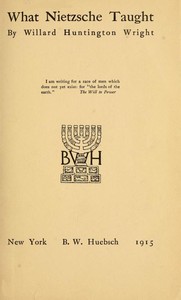
For What Nietzsche Taught — Background and Themes, the stored edition analysis reports 93,857 words, 6 hr 49 min estimated reading time, and 9 detected text sections.
The text analysis averages about 24.3 words per sentence, while the detected sections provide another way to judge how the source is divided.
Project Gutenberg metadata also associates the work with “Philosophy,” connecting these edition facts with the source record’s subject description.
Explore this collection
These alternatives are selected using recorded categories and estimated reading time.
About 398 minutes
Ethics
91,535 recorded words. 11 minutes difference from this book's estimate.
View Gutenberg source #17201About 390 minutes
Ethics
89,551 recorded words. 19 minutes difference from this book's estimate.
View Gutenberg source #22105About 434 minutes
Ethics
99,642 recorded words. 25 minutes difference from this book's estimate.
View Gutenberg source #25110Search stored excerpts and compare books → Choose by your preferences →
Choices use stored catalog measurements. Estimates vary with reading speed. A shared category is a catalog label, not a claim that two books have the same argument or literary quality.
Search reads excerpt text stored with this catalog and links to its associated Gutenberg record. The connection is stored in the site database; this tool does not recheck that every excerpt is word-for-word identical to that external record. Excerpt search does not cover every chapter and does not verify historical publication dates.
Catalog snapshot checked: 2026-09-25. Coverage: 94 public books, 94 available source excerpts.
Read the complete public-domain text at its original source.
Read on Project GutenbergWillard Huntington Wright opens What Nietzsche Taught with a bold claim: Nietzsche's influence on modern thought is undeniable, and no philosopher since Kant has left such an imprint. Wright's introduction immediately positions Nietzsche as a thinker whose ideas have penetrated England and America, countries he describes as "strangely impervious to rigorous philosophic ideals." This framing sets the stage for a work that aims to clarify Nietzsche's teachings for an audience still largely unfamiliar with them. The excerpts reveal Wright's method: he presents Nietzsche's arguments through translated passages and then offers his own commentary, often sharp and evaluative. For a first reader, this structure provides both primary material and a guide to interpretation, though Wright's own biases—such as his admiration for H. L. Mencken—color the presentation.
In the excerpts, Wright focuses on Nietzsche's attack on previous philosophers, particularly Kant and Spinoza. He summarizes Nietzsche's view that these thinkers were "astute defenders of prejudices" who first assumed conclusions and then reasoned backward to justify them. Wright quotes Nietzsche's analysis of the statement "I think," where Nietzsche finds a series of unproven assumptions: that there is an "I" that thinks, that thinking is an activity of a cause, and that we know what thinking is. This passage illustrates Nietzsche's method of questioning foundational assumptions. Wright's commentary emphasizes the personal and instinctive roots of philosophy, arguing that even logic is influenced by physiological considerations. For a first reader, this section demonstrates how Wright selects and highlights Nietzsche's most provocative critiques, making them accessible while also shaping the reader's understanding of Nietzsche's project.
Wright's book is structured around excerpts from Nietzsche's works, each introduced by a biographical or explanatory note. The excerpts themselves are presented in English translation, and Wright often follows them with his own analysis. In the provided text, Wright quotes Nietzsche on the "impulse to knowledge," arguing that philosophy has always been driven by a specific purpose, not a disinterested search for truth. He then connects this to Nietzsche's critique of Kant's "Table of Categories" and the idea of synthetic judgment a priori. Wright's own voice is strong: he describes Nietzsche's reasoning as "sophistical invention" and accounts for its acceptance by the "moral state of the Germans." This interplay between Nietzsche's words and Wright's interpretation is a key feature of the book. Readers should be aware that Wright is not a neutral editor; he actively argues for a particular reading of Nietzsche, one that emphasizes the philosopher's iconoclasm and psychological insight.
Several themes recur in the excerpts that would guide a first reading. First, Nietzsche's insistence on the personal and instinctual basis of philosophy: he asserts that "the whole fabric of philosophic thought is held up to the light of immediate necessity." Second, his critique of truth and certainty: Nietzsche questions whether truth is always valuable, and he suggests that belief, not truth, is what drives philosophical systems. Third, his method of psychological analysis: Nietzsche examines philosophers' motives, finding that their systems are often rationalizations of personal instincts. Wright highlights these themes by grouping Nietzsche's arguments around them, and he often uses Nietzsche's own words to illustrate the point. For example, the passage on "I think" shows Nietzsche's psychological dissection of a seemingly simple statement. A first reader will notice that Wright's selections emphasize Nietzsche as a critic of other philosophers rather than as a builder of his own system, which may shape the reader's initial impression of Nietzsche's philosophy.
The book begins with a biographical sketch of Nietzsche, and each chapter includes an introduction that places the work in context. In the excerpts, Wright mentions that Nietzsche wrote "for a race of men which does not yet exist: for 'the lords of the earth,'" a quote from The Will to Power. This framing suggests that Nietzsche saw himself as a prophet for a future elite. Wright also notes the widespread scholarly interest in Nietzsche, citing a bibliography of 850 titles. For a first reader, these contextual details provide a sense of Nietzsche's reception and Wright's own scholarly stance. However, Wright's biographical sketch is not included in the excerpts, so readers must infer his approach from the introduction and the chapter headings. The table of contents shows that the book covers Nietzsche's major works in chronological order, from Human, All-Too-Human to The Will to Power, which suggests a systematic survey. Wright's notes likely help readers understand the development of Nietzsche's thought, but the excerpts alone do not reveal the full extent of his commentary.
For a first reading, What Nietzsche Taught offers a curated entry into Nietzsche's philosophy, but it is important to recognize Wright's own interpretive lens. He emphasizes Nietzsche's critique of other thinkers and his psychological insights, while downplaying or omitting other aspects. Readers should approach the book as a guide that reflects early 20th-century American reception of Nietzsche, shaped by figures like Mencken. To get the most from this edition, compare Wright's selections with the original works and consider how his framing influences your understanding. The book is best used as a starting point, not a definitive interpretation.
I remember sitting with What Nietzsche Taught and feeling, for the first time, that philosophy could be a companion rather than a lecture. That quiet honesty about Nietzsche's doubts—his own shaking before certainty—reminded me of another long afternoon spent inside On the Ethics of Naturalism — Context and Discussion, where ethics felt less like rules and more like a way of breathing. Both books asked me to slow down, not to agree, but to listen closely.
Use these questions to collect your thoughts before moving on.