About 75 minutes
Life and destiny — A Reader’s Guide
Ethics
17,173 recorded words. 9 minutes difference from this book's estimate.
View Gutenberg source #57752
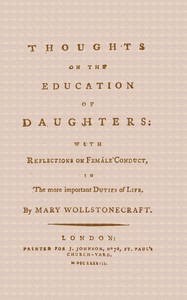
This digital edition of Thoughts on the Education of Daughters With Reflections on Female Conduct, in the More Important Duties of Life — A Closer Reading is described by source-level measurements including 19,180 words, 1 hr 24 min estimated reading time, and 24 detected text sections.
The text analysis averages about 25.8 words per sentence, while the detected sections provide another way to judge how the source is divided.
Project Gutenberg metadata also associates the work with “Women -- Social and moral questions,” connecting these edition facts with the source record’s subject description.
Explore this collection
These alternatives are selected using recorded categories and estimated reading time.
About 75 minutes
Ethics
17,173 recorded words. 9 minutes difference from this book's estimate.
View Gutenberg source #57752About 94 minutes
Ethics
21,612 recorded words. 10 minutes difference from this book's estimate.
View Gutenberg source #12002About 72 minutes
Ethics
16,428 recorded words. 12 minutes difference from this book's estimate.
View Gutenberg source #5684Search stored excerpts and compare books → Choose by your preferences →
Choices use stored catalog measurements. Estimates vary with reading speed. A shared category is a catalog label, not a claim that two books have the same argument or literary quality.
Search reads excerpt text stored with this catalog and links to its associated Gutenberg record. The connection is stored in the site database; this tool does not recheck that every excerpt is word-for-word identical to that external record. Excerpt search does not cover every chapter and does not verify historical publication dates.
Catalog snapshot checked: 2026-09-25. Coverage: 94 public books, 94 available source excerpts.
Read the complete public-domain text at its original source.
Read on Project GutenbergMary Wollstonecraft opens her 1787 treatise with a striking contrast between human and animal parenting: 'reason and duty together have not so powerful an influence over human conduct, as instinct has in the brute creation.' This early sentence establishes the book's central method—using observable, everyday failings to argue for deliberate, rational education. Wollstonecraft does not write as a distant moralist but as someone who has watched mothers 'follow a pleasing impulse' and neglect their children. Her preface warns that the reflections may be 'too grave' for some, but she refuses to 'write affectedly.' The result is a work that grounds its moral arguments in concrete domestic scenes, from nursing to card-playing, and insists that women's souls 'ought to be attended to' with the same seriousness as men's.
Wollstonecraft begins not with abstract principles but with the physical care of infants. She insists that mothers 'ought to suckle their children' unless prevented by 'very weighty reasons,' and argues that a 'regular mode of suckling' would make the task far from laborious. This is not merely a practical recommendation; it is a claim about attention and habit. She observes that many mothers have 'momentary starts of tenderness' but lack sustained discipline, allowing 'vanity and self-love' to dominate. The nursery, in her view, is where the foundation of a 'good constitution' is laid—both physical and moral. She warns that instincts left ungoverned 'will run wild,' a phrase that echoes through later sections on passion and reason. By starting with the body, Wollstonecraft anchors her moral philosophy in observable, daily choices.
In the chapter on matrimony, Wollstonecraft argues that early marriage 'is a stop to improvement.' She quotes the cynical view that humans are born only 'to draw nutrition, propagate and rot,' then counters it with a sharp reminder: 'as women are here allowed to have souls, the soul ought to be attended to.' The phrasing is deliberately provocative—'here allowed' suggests that this is not a universally granted premise. She observes that young women marry before twenty the very men they would reject years later, when their minds have matured. The problem is not just bad choices but a lack of time for reflection. Even with a good husband, a woman 'will not set a proper value on him' because her expectations have been shaped by novels. Wollstonecraft’s diction is precise: she distinguishes 'fondness' from 'tenderness' and warns that too much familiarity breeds contempt.
Throughout the book, Wollstonecraft returns to the idea that 'universal benevolence is the first duty.' But her tone is not merely didactic; it is shaped by a recognition of disappointment. She writes that 'the tumult of passion will subside' and even 'the pangs of disappointment cease to be felt,' yet for the wicked there remains 'a worm that never dies—a guilty conscience.' This is not a conventional religious threat but a psychological observation. The 'calm satisfaction which resignation produces' is described as something that 'cannot be described, but may be attained.' The paradox is deliberate: she points to an inner state that language cannot fully capture, yet she tries to evoke it through the rhythm of her sentences. The prose itself enacts the struggle between passion and reason.
Wollstonecraft’s word choices repeatedly assert women’s capacity for reason. She speaks of 'the duty of every rational creature' and insists that women 'have souls' that require cultivation. Her vocabulary is drawn from moral philosophy—'duty,' 'reason,' 'principle,' 'judgment'—but she applies it to domestic scenes: a mother’s milk, a girl’s reading, a wife’s 'artless proofs of regard.' She avoids the sentimental language common in conduct books; instead, she uses concrete nouns and active verbs. When she writes that 'the mind does not soon arrive at maturity,' she is making a claim about development that applies equally to both sexes. The book’s structure—moving from nursery to marriage to public places—mirrors the stages of a woman’s life, but each stage is examined through the lens of rational choice. Even her chapter on 'Card-Playing' becomes an occasion to discuss the misuse of time.
Wollstonecraft’s treatise rewards readers who attend to its specific observations rather than its general moralizing. The force of the argument lies in the details: a mother’s neglect, a young wife’s disappointment, the quiet dignity of resignation. These are not abstract positions but lived experiences, rendered in a voice that is at once grave and urgent. For those interested in the history of educational thought, the book offers a rare glimpse of an eighteenth-century woman writer using the conduct-book genre to argue for intellectual equality—one concrete example at a time.
There’s a particular quiet that settles in when reading Wollstonecraft’s early arguments—she’s so certain, so gently unyielding, that I feel I’m overhearing a private conviction. It reminds me of another voice, patient and strange, in The Works of Sir Thomas Browne, Volume 2 — A Closer Reading. Both carry that earnest, almost lonely care for how a mind ought to be tended.
Capture what you thought, learned, and would like to remember.