About 841 minutes
Plato and the Other Companions of Sokrates, 3rd ed. Volume 3 — A Reader’s Guide
Ethics
193,316 recorded words. 10 minutes difference from this book's estimate.
View Gutenberg source #40437
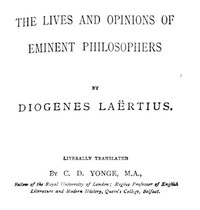
Before opening The Lives and Opinions of Eminent Philosophers — A Reader’s Guide, the edition data offers a quick orientation: 195,554 words, 14 hr 11 min estimated reading time, and 26 detected text sections.
The text analysis averages about 28.2 words per sentence, while the detected sections provide another way to judge how the source is divided.
Project Gutenberg metadata also associates the work with “Philosophy, Ancient,” connecting these edition facts with the source record’s subject description.
Explore this collection
These alternatives are selected using recorded categories and estimated reading time.
About 841 minutes
Ethics
193,316 recorded words. 10 minutes difference from this book's estimate.
View Gutenberg source #40437About 871 minutes
Ethics
200,189 recorded words. 20 minutes difference from this book's estimate.
View Gutenberg source #39713About 816 minutes
Ethics
187,669 recorded words. 35 minutes difference from this book's estimate.
View Gutenberg source #40436Search stored excerpts and compare books → Choose by your preferences →
Choices use stored catalog measurements. Estimates vary with reading speed. A shared category is a catalog label, not a claim that two books have the same argument or literary quality.
Search reads excerpt text stored with this catalog and links to its associated Gutenberg record. The connection is stored in the site database; this tool does not recheck that every excerpt is word-for-word identical to that external record. Excerpt search does not cover every chapter and does not verify historical publication dates.
Catalog snapshot checked: 2026-09-25. Coverage: 94 public books, 94 available source excerpts.
Read the complete public-domain text at its original source.
Read on Project GutenbergDiogenes Laërtius organizes his history of Greek philosophy into two broad streams: the Ionic, beginning with Anaximander and ending with Theophrastus, and the Italian, starting with Pythagoras and concluding with Epicurus. This structural division shapes the entire work, as each philosopher is placed within a lineage that emphasizes intellectual inheritance and divergence. The excerpts reveal a consistent pattern: each entry moves from biographical origins to characteristic sayings and memorable interactions, often concluding with a list of writings. The anecdotes, such as Zeno's retort to a verbose youth—"Your ears have run down into your tongue"—serve not merely as entertainment but as compressed demonstrations of philosophical character.
The excerpts show that Diogenes Laërtius frequently uses pointed anecdotes to convey a philosopher's core teachings. Zeno's rebukes, for instance, are not random insults but pedagogical tools: he leads a pertinacious youth to a mirror, asks whether his questions suit his face, and thereby enacts the Socratic method of self-examination. Similarly, when a man dismisses Antisthenes' doctrines, Zeno quotes Sophocles to expose selective memory. These vignettes compress complex ethical positions into memorable scenes. The reader should attend to how each story encapsulates a principle—such as Zeno's insistence that arguments must be concise, like the syllables of philosophy itself. The structure of these anecdotes often follows a pattern: a provocation, a physical or verbal gesture, and a concluding maxim. This recurring form suggests that Diogenes valued the dramatic embodiment of ideas over abstract exposition.
Diogenes traces philosophical lineages by showing how one thinker responds to another. In the excerpts, Zeno's criticisms of Polemo and Ariston reveal internal debates within the Stoic and Academic traditions. The text also moves geographically: from Athens to Cyrene, from Elea to Abdera. This geographical and temporal movement is not merely background; it structures the narrative. For example, the Italian school begins with Pythagoras in southern Italy and ends with Epicurus in Athens, implying a transfer of intellectual authority. The reader will notice that transitions between philosophers often hinge on a shared teacher-student relationship or a doctrinal dispute. Diogenes frequently notes who studied under whom, creating a web of influence that the reader can trace. This emphasis on succession suggests that the work is as much about the transmission of ideas as about individual lives.
Certain images recur across the excerpts, linking disparate philosophers. The mirror appears when Zeno confronts a youth; the looking-glass becomes a tool for philosophical reflection. Fish and dining scenes surface repeatedly: Zeno takes an entire fish to shame an epicure, and later compares a discourse to boiled meat. These concrete objects ground abstract arguments in everyday life. Dirty cloaks also feature: Zeno makes a wealthy Rhodian sit on dusty seats to test his commitment. Such images serve as mnemonic devices, helping the reader recall a philosopher's stance on vanity or self-control. Diogenes seems to select these details not for biographical completeness but for their illustrative power. The reader should watch for how a single object—a mirror, a fish, a cloak—can encapsulate an entire ethical position. This technique gives the text a vivid, almost theatrical quality, where props carry philosophical weight.
Charles Duke Yonge's 1915 translation, part of Bohn's Classical Library, shapes the reader's experience through its Victorian prose style. Yonge, a Regius Professor, favors formal diction and periodic sentences, which lend dignity to the anecdotes but may distance modern readers. For instance, Zeno's sharp retorts are rendered as "Are you not then ashamed" rather than a more colloquial phrasing. The translation also includes extensive footnotes and a preface that situates Diogenes in the second century CE. Yonge's choices affect how the structure and movement of the original are perceived: his paragraphing often isolates anecdotes, making each a discrete unit. Readers should consider how the translation's rhythm influences the pacing of philosophical succession. Comparing Yonge's version with a more recent translation might reveal how different eras interpret Diogenes' blend of biography and doxography.
Diogenes Laërtius's work rewards readers who move between the lives, noting how a saying in one entry echoes or contradicts another. The structure invites nonlinear reading: one might start with a familiar figure like Socrates and then follow the threads to his predecessors and successors. The recurring images and anecdotal patterns provide a consistent framework, while the translation's style adds a layer of historical texture. Approach this text as a collection of intellectual portraits, each a snapshot of a philosophical stance enacted in daily life.
There’s something touching about Diogenes Laërtius’s old habit of lingering over a philosopher’s quirks—the way he collects sayings rather than systems. It reminds me of opening Hegel's Lectures on the History of Philosophy: Volume 2 (of 3) — A Reader’s Guide and finding, amid the abstractions, an unexpected warmth for those same ancient voices. Both books feel like sitting with old friends, hearing their stories again.
Create a short personal record of your experience with this book.