About 141 minutes
Youth and Sex: Dangers and Safeguards for Girls and Boys — Inside the Classic
Ethics
32,348 recorded words. 3 minutes difference from this book's estimate.
View Gutenberg source #13722
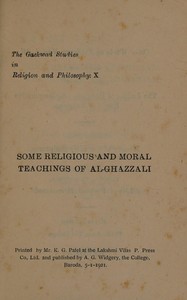
For Some religious and moral teachings of Al-Ghazzali — Key Ideas to Explore, the stored edition analysis reports 31,591 words, 2 hr 18 min estimated reading time, and 15 detected text sections.
The text analysis averages about 17.7 words per sentence, while the detected sections provide another way to judge how the source is divided.
Project Gutenberg metadata also associates the work with “Islamic ethics -- Early works to 1800,” connecting these edition facts with the source record’s subject description.
Explore this collection
These alternatives are selected using recorded categories and estimated reading time.
About 141 minutes
Ethics
32,348 recorded words. 3 minutes difference from this book's estimate.
View Gutenberg source #13722About 145 minutes
Ethics
33,219 recorded words. 7 minutes difference from this book's estimate.
View Gutenberg source #15563About 149 minutes
Ethics
34,085 recorded words. 11 minutes difference from this book's estimate.
View Gutenberg source #5682Search stored excerpts and compare books → Choose by your preferences →
Choices use stored catalog measurements. Estimates vary with reading speed. A shared category is a catalog label, not a claim that two books have the same argument or literary quality.
Search reads excerpt text stored with this catalog and links to its associated Gutenberg record. The connection is stored in the site database; this tool does not recheck that every excerpt is word-for-word identical to that external record. Excerpt search does not cover every chapter and does not verify historical publication dates.
Catalog snapshot checked: 2026-09-25. Coverage: 94 public books, 94 available source excerpts.
Read the complete public-domain text at its original source.
Read on Project GutenbergThe extracts in this volume, drawn from Al-Ghazzali's Ihya-u-Ulum-id-din, are presented as a constructive contribution to interfaith understanding, as stated in the preface. The translator, Syed Nawab Ali, renders the text freely into English, and the introduction by Alban G. Widgery frames the work within the Gaekwad Studies in Religion and Philosophy series. The excerpts focus on human nature, love, and sincerity, with a recurring emphasis on the inner senses and the soul's attraction to the divine.
The excerpt on the nature of love outlines a systematic classification of love based on perception. Al-Ghazzali distinguishes between love arising from the five senses, shared with animals, and a sixth sense peculiar to humans, which delights the soul. He cites a hadith where the prophet describes prayer as the 'delight of my eye,' interpreting this as the inner eye or soul. The text then enumerates three causes of love: self-love, love for benefactors, and love of beauty. Beauty is defined not merely by physical appearance but as the possession of all befitting perfections, varying by object—a horse, writing, or a person each have their own standard. This analytical approach, breaking down love into categories and causes, is characteristic of the work's method.
A passage on sincerity warns that even those who aim for a high standard may be deceived by hidden sensuous pleasures. The text advises that after exertion and reflection on one's motive, a person should not be over-confident of sincerity. Instead, one should fear rejection and hope for acceptance—'this is the creed of the righteous.' This practical caution reflects a psychological realism about human self-deception. The discussion uses the example of a warrior who acquires booty: if his sole motive is to uphold religion, the latent desire for booty does not invalidate his recompense, yet he is inferior to those wholly absorbed in God. The passage thus balances moral standards with compassion for human frailty.
The preface and introduction reveal the editorial context. The volume is part of the Gaekwad Studies in Religion and Philosophy, which aims to be constructive rather than critical, appealing to both scholars and the general public. The translator, Syed Nawab Ali, notes that the work was undertaken at the request of Professor Widgery, who also reviewed the manuscript. The preface expresses hope that such translations will promote mutual respect among religious devotees. The excerpts are described as 'brief extracts' from Al-Ghazzali's larger work, and the translation is 'freely rendered,' indicating a degree of interpretive liberty. This framing positions the text as a bridge for English-speaking readers to access Islamic spiritual thought.
Readers should note that these extracts represent a selection from a much larger work, and the translator's 'free rendering' may shape the tone. The text is best approached as a window into Al-Ghazzali's method of combining philosophical analysis with spiritual counsel. Pay attention to how he uses hadith and everyday examples to ground abstract concepts, and consider the interplay between the translator's choices and the original Arabic-Persian context.
That rainy afternoon, Al-Ghazzali's quiet insistence on sincerity softened something in me. I lingered over his words about the heart’s intent, then set the book aside. My hand drifted to another volume, almost by accident—The Morality of Woman, and Other Essays — Edition Insights. Its tone felt like a conversation continuing in a lower voice, asking different questions about the same inner life.
A brief reflection can help important ideas stay with you longer.