About 610 minutes
A History of Philosophy in Epitome — Inside the Classic
Ethics
140,206 recorded words. 1 minutes difference from this book's estimate.
View Gutenberg source #41412
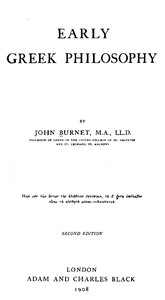
The source record for Early Greek philosophy — Themes and Context measures this digital text at 139,905 words, 10 hr 9 min estimated reading time, and 38 detected text sections.
The text analysis averages about 17.3 words per sentence, while the detected sections provide another way to judge how the source is divided.
Project Gutenberg metadata also associates the work with “Philosophy, Ancient,” connecting these edition facts with the source record’s subject description.
Explore this collection
These alternatives are selected using recorded categories and estimated reading time.
About 610 minutes
Ethics
140,206 recorded words. 1 minutes difference from this book's estimate.
View Gutenberg source #41412About 596 minutes
Ethics
137,052 recorded words. 13 minutes difference from this book's estimate.
View Gutenberg source #73430About 643 minutes
Ethics
147,853 recorded words. 34 minutes difference from this book's estimate.
View Gutenberg source #36208Search stored excerpts and compare books → Choose by your preferences →
Choices use stored catalog measurements. Estimates vary with reading speed. A shared category is a catalog label, not a claim that two books have the same argument or literary quality.
Search reads excerpt text stored with this catalog and links to its associated Gutenberg record. The connection is stored in the site database; this tool does not recheck that every excerpt is word-for-word identical to that external record. Excerpt search does not cover every chapter and does not verify historical publication dates.
Catalog snapshot checked: 2026-09-25. Coverage: 94 public books, 94 available source excerpts.
Read the complete public-domain text at its original source.
Read on Project GutenbergBurnet opens his second edition by acknowledging that most of the volume had to be rewritten in light of discoveries made since 1892, especially the extracts from Menon's Ἰατρικά, which he believes provide a clue to the history of Pythagoreanism. He retains what he calls a 'certain youthful assurance' from the first edition, written when he was twenty-five, and notes that his main contentions remain sound. The preface signals a work deeply engaged with philological evidence and scholarly debate, not a mere summary.
The two prefaces reveal Burnet's approach. He states that his original intention was simply to report the results of recent progress in philology, but he soon found himself dissenting from some conclusions. He warns that his mistakes may be useful in calling attention to unobserved points. This honesty sets the tone: Burnet does not present a neutral survey but an argumentative reconstruction. He also adapts references to Zeller and Ritter & Preller to the latest editions, and cites Aristotelian commentators by the Berlin Academy edition. Readers should expect frequent engagement with textual variants and scholarly disagreements.
Burnet's text is built around fragments from Presocratic thinkers, often quoted in Greek with detailed notes. For example, in discussing Parmenides, he argues against the translation 'thought and being are the same,' calling it a philosophical anachronism. He proposes alternative readings, such as τὸ γὰρ αὐτὸ νοεῖν ἔστιν τε καὶ εἶναι, and defends his construal of ἔστι γὰρ οὐλομελές over μουνογενές. These technical decisions shape his interpretation. The reader must attend to the footnotes, where Burnet justifies his choices with reference to manuscript traditions and earlier editors.
Burnet singles out the discovery of extracts from Menon's Ἰατρικά as a key to Pythagorean history. He does not elaborate in the preface, but this clue reappears in the body of the work. The excerpts show that Burnet treats Pythagoreanism as a developing tradition, not a fixed doctrine. He also notes that Simplicius had access to the library of the Academy, while Proclus seems to have used a different manuscript. Such observations ground his arguments in the material conditions of textual transmission. Readers should watch for how Burnet weighs the authority of later commentators against earlier sources.
The book proceeds chronologically from the Milesians to the Atomists, but Burnet's focus is on reconstructing the arguments of each thinker from the fragments. He frequently cites Aristotle and Simplicius as sources, but he is critical of their interpretations. For instance, he rejects the idea that Parmenides identified thought and being, and he reads the παλίντροπος κέλευθος as equivalent to Heraclitus's 'way up and down.' The notes are dense with cross-references, and Burnet often corrects earlier editors. A first-time reader may find the philological detail challenging, but the preface's promise of 'youthful assurance' suggests a clear, if contentious, line of argument.
Burnet frequently quotes Greek without translation, assuming a reader familiar with the language. However, his notes often paraphrase or explain key terms. For example, he glosses φατίζειν as equivalent to ὀνομάζειν, and he explains that ἔστι νοεῖν means 'can be thought.' The reader who does not know Greek will need to rely on Burnet's English summaries, but the argumentative force of his textual decisions may be lost. The book is thus best suited to those with some background in classical philology, though the prefaces and introductory sections offer a way in for the determined general reader.
Burnet's Early Greek Philosophy is not a passive survey but a sustained argument about how to read the fragments. The prefaces and footnotes are essential to understanding his positions. Readers should approach the text with attention to the evidence Burnet cites and the scholarly debates he enters. The book rewards careful study but demands patience with its technical apparatus.
Holding Burnet’s old book, I kept thinking of the way he lingers over a single word in a fragment, as if it were a seashell still wet. That patient closeness to the text is what I recall now, turning to Natural Philosophy — Context and Discussion, where the same quiet attention seems to sit, unhurried, between the lines.
Use these questions to collect your thoughts before moving on.