
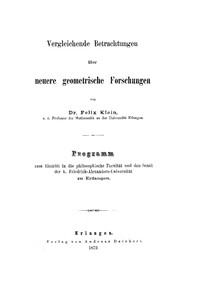
Vergleichende Betrachtungen über neuere geometrische Forschungen by Felix Klein
The Story
This isn't a book with a plot in the usual sense. Instead, it presents a single, powerful argument. In 1872, a young Felix Klein gave a lecture that asked a radical question: what if we could organize all of geometry not by the shapes we draw, but by the rules we allow for transforming them?
He proposed that every type of geometry—Euclidean, projective, you name it—is defined by the 'symmetries' or transformations that leave its core truths intact. Think of it like this: the rules of a game define what moves are allowed. Klein said we should classify geometries by their 'allowed moves.' This idea, called the Erlangen Program, became a blueprint for modern mathematics.
Why You Should Read It
It's a shockingly clear vision from a 23-year-old. You feel the excitement of someone connecting dots that no one had linked before. The beauty is in the shift in perspective. Instead of seeing geometry as a collection of separate facts, Klein shows it as a unified landscape where everything is connected by a simple, elegant principle. It turns a messy subject into something with a clean, logical structure.
Final Verdict
This is for the curious thinker, not the casual reader. It's perfect for anyone interested in the history of big ideas, students of math or physics who want to see where modern concepts began, or readers who enjoy short, dense works that pack a massive intellectual punch. Don't expect a light read, but do expect to encounter the seed of a thought that grew to shape a century of science.
There are no legal restrictions on this material. Enjoy reading and sharing without restrictions.
Linda Jackson
11 months agoI started reading out of curiosity and the flow of the text seems very fluid. Exceeded all my expectations.
Charles Robinson
5 months agoLoved it.
Deborah Scott
1 year agoSimply put, the author's voice is distinct and makes complex topics easy to digest. Definitely a 5-star read.
Mark Robinson
1 year agoHaving read this twice, the atmosphere created is totally immersive. A valuable addition to my collection.




Kenneth Moore
1 year agoFive stars!