
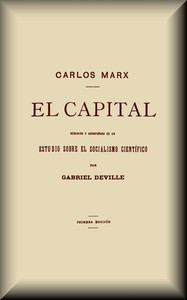
El capital: Resumido y acompañado de un estudio sobre el Socialismo científico
Okay, let's be honest. Most of us aren't going to sit down and read all three volumes of Karl Marx's Capital. It's famously dense, packed with economic theory, and, let's face it, pretty intimidating. That's where Gabriel Deville comes in. In the late 19th century, he did what a good friend does: he read the big, complicated book and gave us the clear, straightforward summary.
The Story
This isn't a story with characters and a plot. It's the story of an economic system. Deville's book has two main parts. First, he walks us through the core ideas of Capital. He explains Marx's concepts of commodities, surplus value (the idea that workers create more value than their wages), and capital accumulation in a way that's much easier to follow. He strips away the complex examples to show the skeleton of the argument: how capitalism works by design to generate profit for owners at the expense of laborers.
The second part is his essay on 'scientific socialism.' This is where Deville argues that socialism isn't just a moral wish but a scientific prediction. He tries to show how the internal contradictions of capitalism, which Marx outlined, make its transition to socialism a historical inevitability, not just a hopeful dream.
Why You Should Read It
I picked this up because I wanted to understand a hugely influential idea without getting lost in the weeds. Deville is your guide. He doesn't add much new theory; his genius is in simplification. Reading him feels like having a patient tutor explain a difficult subject. You get the core of Marx's critique—the exploitation, the crisis tendencies, the historical materialist perspective—without drowning in detail. The 'scientific socialism' section is particularly fascinating as a historical document. It captures the absolute certainty that many early socialists felt about their cause, a belief that history itself was on their side. It’s a powerful glimpse into a mindset that shaped the 20th century.
Final Verdict
This book is perfect for curious readers, history fans, or anyone in a political science or economics class who needs a clearer entry point to Marx's economic thought. It's not for people seeking a deep, original philosophical treatise—go to Marx himself for that. But if you want a surprisingly readable, historically significant summary that cuts to the chase, Deville's little book is a brilliant tool. Just remember it's a summary from 1883, so read it as a gateway and a historical artifact, not the final word.
This historical work is free of copyright protections. It serves as a testament to our shared literary heritage.







Lisa Hernandez
1 year agoGood quality content.