
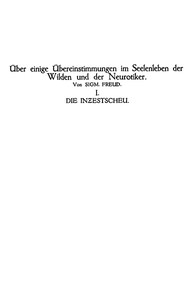
Die Inzestscheu by Sigmund Freud
Alright, let's break this one down. 'Die Inzestscheu' isn't a novel. Don't go in expecting a plot with a beginning, middle, and end. Instead, think of it as Freud laying out a grand theory for one of humanity's biggest, oldest puzzles.
The Story
The 'story' here is the story of human society. Freud starts with a simple observation: nearly every culture has a strict, powerful taboo against incest. He asks, 'Why?' His answer forms the core of the book. He connects this taboo directly to his famous Oedipus complex. In his view, young children naturally have strong, possessive feelings toward the parent of the opposite sex and see the same-sex parent as a rival. To grow into a functional adult and to allow society to form, this primal desire must be repressed and redirected. The incest taboo, Freud argues, is the social and psychological mechanism that forces this to happen. It's the rule that breaks up the primal family unit and pushes people to seek partners outside their immediate family, creating alliances and building the wider social networks that become tribes, communities, and civilizations. The conflict is internal (the child's repressed desires) and external (the society's absolute law).
Why You Should Read It
Look, Freud is controversial. A lot of his specific ideas haven't held up to modern science. But reading this is less about agreeing with every detail and more about witnessing a seismic shift in how we think about ourselves. Before Freud, rules like the incest taboo were often explained by religion, tradition, or simple morality. Freud dared to say, 'No, this comes from inside us. It's baked into the messy, unconscious drama of family life.' That's a breathtaking idea. It makes you look at every 'just because' rule in a new light. Reading him is like watching someone turn on a flashlight in a dark, unexplored room of the human experience—even if the flashlight beam is a bit wobbly and shows some strange shadows.
Final Verdict
This is not a beach read. It's for the intellectually curious, the person who likes to question the foundations of everyday life. It's perfect for anyone interested in the history of ideas, psychology, or anthropology. If you've ever wondered why we have the social rules we do, and you're willing to wrestle with some challenging, provocative (and yes, sometimes infuriating) theories from one of history's most influential thinkers, give it a go. Just be prepared to argue with the book in the margins. That's half the fun.
This is a copyright-free edition. Use this text in your own projects freely.
Richard Anderson
1 year agoHelped me clear up some confusion on the topic.
Mason Young
5 months agoBeautifully written.
Daniel Torres
2 years agoI was skeptical at first, but the depth of research presented here is truly commendable. Don't hesitate to start reading.
Linda Rodriguez
1 year agoThe index links actually work, which is rare!




Aiden Smith
3 months agoFive stars!