
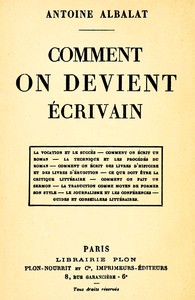
Comment on devient écrivain by Antoine Albalat
Published in 1905, Antoine Albalat’s Comment on devient écrivain isn’t a novel or a memoir. It’s a practical guide, but one written with the passion of a true book lover. Albalat was a literary critic who got tired of vague advice about 'finding your voice.' He decided to write a book that showed, step-by-step, how great writing is built from the ground up.
The Story
There’s no plot in the traditional sense. Instead, think of it as a friendly, if slightly stern, masterclass. Albalat walks you through the entire process. He starts with the absolute basics: how to read like a writer, absorbing style and technique from the masters. He then moves on to the grunt work—taking notes, observing the world, building a vocabulary. The real heart of the book, and what made it famous, is his focus on revision. He doesn’t just tell you to edit; he shows you. He reproduces early drafts from giants like Gustave Flaubert and Victor Hugo, placing them side-by-side with the final, published versions. You see the clumsy phrase that became elegant, the redundant paragraph that got cut, the weak verb that was replaced with a perfect one. It’s a lesson in humility and craftsmanship.
Why You Should Read It
I found this book incredibly freeing. In an age of social media where everyone’s final, polished product is on display, Albalat drags the messy, frustrating, essential process of revision into the light. It demolishes the myth of the perfect first draft. Reading it, you realize that even the authors we consider geniuses started with awkward, mediocre sentences. Their genius was in their willingness to fix them. It turns writing from a mysterious talent into a series of clear, if difficult, tasks. You won’t agree with all of Albalat’s old-fashioned opinions (he has some strong feelings about certain words!), but his core message—that good writing is rewritten writing—is timeless.
Final Verdict
This is a must-read for aspiring writers who are serious about the craft and tired of fluffy inspiration. It’s also a fantastic read for any serious bookworm who wants to understand literature on a deeper level, to see the seams and stitches in their favorite works. Because it’s a century old, the prose has a formal charm, and the examples are all from classic French literature, so it helps if you have a passing interest in that. But the principles it teaches are universal. Perfect for the practical-minded creative, the curious reader, and anyone who needs proof that great things are built, not born.
This work has been identified as being free of known copyright restrictions. You are welcome to share this with anyone.
Elijah Smith
2 months agoTo be perfectly clear, the narrative structure is incredibly compelling. I will read more from this author.
Brian Harris
2 years agoGreat reference material for my coursework.
Susan Robinson
7 months agoHelped me clear up some confusion on the topic.
Ashley Harris
1 year agoSurprisingly enough, the storytelling feels authentic and emotionally grounded. Worth every second.




Jackson Harris
1 year agoI stumbled upon this title and the depth of research presented here is truly commendable. Thanks for sharing this review.